
Abstract
Asexual or vegetative propagation plays a crucial role in horticultural crop production by enabling the multiplication of true-to-type plants from selected elite varieties. Although sexual propagation is practiced in certain crops, it often results in genetic variability, making asexual methods more suitable for maintaining uniformity and desired traits. Vegetative propagation may occur naturally through specialized plant structures or be carried out artificially through human intervention for commercial and research purposes. The major methods of asexual propagation include cutting, layering, budding and grafting. This article focuses on cutting, layering and budding techniques. Cutting involves the use of different plant parts such as roots, stems, leaves and scions. Layering methods include simple, tip, serpentine (compound), trench, mound and air layering. Budding techniques encompass T or shield budding, inverted T, chip, patch, flute and ring (annular) budding. The selection of appropriate plant material and propagation method is fundamental for successful multiplication in the horticultural industry, ensuring the production of high-quality, uniform planting material.
Keywords: Asexual/vegetative plant propagation, propagation of fruit plants, cutting, layering, budding.
INTRODUCTION
Fruit crops can be propagated through two principal approaches: sexual propagation by seeds and asexual (vegetative) propagation through methods such as grafting. However, most fruit plants raised from seeds do not maintain true-to-type characteristics, resulting in variability in growth, yield and fruit quality. To overcome these limitations, asexual propagation is widely adopted, as it ensures the production of genetically identical plants (clones) that exhibit uniformity in yield, fruit size and overall quality.
Although seedling plants may sometimes produce higher yields, they are often associated with inferior fruit quality, extended juvenile phases and excessive vegetative growth, which complicate management practices such as plant protection and harvesting. Additionally, non-uniform fruit maturity in seedling plants poses challenges in marketing and reduces economic returns.
Considering these drawbacks, vegetative propagation has become essential for achieving consistency and efficiency in fruit production. The major asexual propagation methods include cutting, layering, budding, and grafting. This article primarily focuses on the first three techniques like cutting, layering and budding highlighting their importance and applications in fruit crop propagation.
PLANT PROPAGATION
Plant propagation is the art and science of producing new plants from existing ones. It forms the backbone of horticulture, enabling the multiplication of crops with desirable traits. Broadly, propagation is classified into two types: sexual and asexual. Sexual propagation involves the fusion of male and female gametes, resulting in the formation of seeds that give rise to genetically diverse plants. In contrast, asexual or vegetative propagation utilizes plant parts such as stems, roots, or leaves to produce new plants that are genetically identical to the parent.
Sexual propagation offers advantages such as cost-effectiveness, the possibility of developing new varieties and avoidance of certain diseases. However, asexual propagation is often preferred in horticulture because it ensures uniformity, preserves elite traits and reduces the juvenile phase in many crops.
SEXUAL PROPAGATION
Sexual propagation occurs through the formation of seeds following fertilization. A seed consists of three main components: the protective seed coat, the food reserve known as the endosperm and the embryo, which develops into a new plant. Under favourable environmental conditions, seeds germinate and initiate plant growth.
In horticulture crops, seeds are usually sourced from reliable suppliers, with hybrid seeds being widely used due to their superior performance. However, seeds saved from open-pollinated plants may not always produce true-to-type offspring due to natural cross-pollination.
SEED GERMINATION: THE BEGINNING OF PLANT LIFE
Germination is a critical phase in the plant life cycle and begins when internal and external conditions are favourable. A viable seed must possess a well-developed embryo, sufficient food reserves and the necessary hormonal balance to trigger growth. Typically, only 60–75% of seeds develop into healthy seedlings under optimal conditions.
Four key environmental factors influence germination:
Temperature: Regulates both the rate and percentage of germination, with each species having specific requirements.
Water: Essential for activating metabolic processes through imbibition.
Light: May either promote or inhibit germination depending on the species.
Oxygen: Required for respiration; hence, a well-aerated medium is necessary.
Temperature: Regulates both the rate and percentage of germination, with each species having specific requirements.
GERMINATION MEDIA AND CONTAINERS
A suitable growing medium is vital for successful seed germination. It should be fine-textured, well-aerated, free from pathogens and weeds and capable of retaining adequate moisture. Commonly used media include mixtures of soil, sand and organic materials like peat moss, as well as soilless substrates such as vermiculite and perlite.
Containers for raising seedlings can range from nursery trays and pots to recycled materials, provided they ensure proper drainage.
SEED SOWING AND CARE
Proper sowing practices are essential for healthy seedling development. Seeds should be sown at an appropriate depth generally twice their diameter and spaced adequately to allow for proper growth. After sowing, the medium should be kept moist but not waterlogged.
Careful watering, preferably through misting systems, helps maintain uniform moisture levels. Seedlings must also receive adequate light and temperature conditions to avoid weak and elongated growth.
TRANSPLANTING AND HARDENING
Seedlings should be transplanted at the right stage, usually when the first true leaves appear. Proper handling during transplanting minimizes root damage and ensures better establishment.
Before transferring seedlings to field conditions, they must undergo a hardening process. This gradual exposure to external environmental conditions helps plants adapt and reduces transplant shock.
ASEXUAL PROPAGATION
Asexual propagation is widely practiced to maintain the genetic identity of superior plants. It involves methods such as cuttings, layering, division, budding and grafting. Among these, cuttings and layering are commonly used due to their simplicity and effectiveness.
CUTTINGS
Cutting is a popular method where a part of the plant is induced to form roots and develop into a new plant. It is widely used for both woody and herbaceous species.
- Stem Cuttings: Includes tip, medium, cane and heel cuttings, depending on the plant type and method used.
- Leaf Cuttings: Suitable for certain indoor plants, where leaves or leaf sections give rise to new plants.
- Root Cuttings: Typically taken from mature plants during the dormant season, capable of producing new shoots and roots.
LAYERING
Layering involves inducing roots on a stem while it remains attached to the parent plant. Once roots develop, the stem is detached to form an independent plant. This method ensures a high success rate as the developing plant continues to receive nutrients from the parent during root formation.
The following propagation techniques are classified under layering, as new plants develop while still attached to the parent plant.
Tip layering: In this method, a hole about 3–4 inches deep is prepared and the tip of a shoot is inserted and covered with soil. Initially, the tip grows downward, then curves upward sharply. Root formation occurs at the bend and the curved tip develops into a new plant. The rooted layer can be separated and transplanted during early spring or late autumn. This method is commonly used in crops such as purple and black raspberries and trailing blackberries.
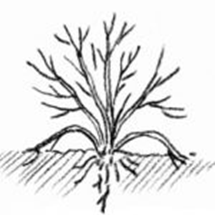
Compound layering: This technique is suitable for plants with long, flexible stems. The stem is bent towards the rooting medium, similar to simple layering, but is alternately buried and exposed at different sections. The portions that are covered are usually wounded on the lower side to promote root formation. This method is commonly practiced in plants like heart-leaf philodendron and pothos.
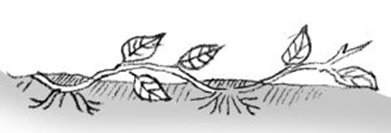
Mound (stool) layering: In this method, the plant is cut back to about 1 inch above ground level during the dormant season. As new shoots emerge in spring, soil is gradually heaped around their bases to encourage root development. This technique is commonly used in crops such as gooseberries and apple rootstocks.
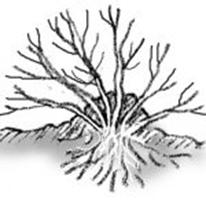
Air layering: This method is commonly used for propagating indoor plants with thick stems or for rejuvenating overgrown, leggy plants. A cut is made just below a node and the slit is gently kept open using a small support such as a toothpick. The wounded area is then covered with moist sphagnum moss and wrapped securely with plastic or foil to retain moisture. Once roots develop within the moss, the rooted portion is cut below the root mass and planted separately.
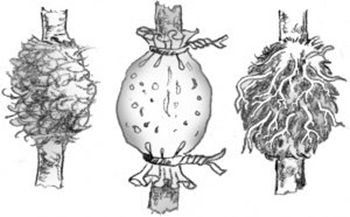
Simple layering: In this method, a flexible stem is bent down to the ground and a portion of it is covered with soil, leaving the terminal 6–12 inches exposed. The exposed tip is then positioned upright and supported with a stake. Rooting typically occurs at the bent section and it can be further encouraged by slightly wounding the underside of the stem or gently twisting it to loosen the bark.
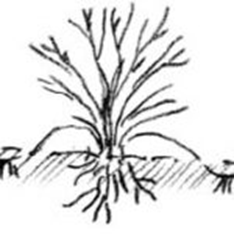
Division: Plants possessing multiple rooted crowns can be separated into individual sections and replanted independently. When the stems are not interconnected, the plant parts can be gently pulled apart. However, if the crowns are linked by horizontal stems, they should be carefully cut using a sharp knife to reduce damage. In some outdoor plants, it is advisable to treat the divided portions with a fungicide before replanting to prevent infections.
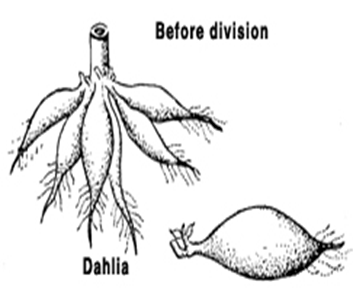
Separation:
Separation refers to a method of propagation commonly used in plants that reproduce through bulbs or corms.
Bulbs: New bulbs develop alongside the parent bulb, forming clusters over time. These clumps should be separated every 3–5 years to promote larger blooms and increase bulb numbers. The clump is usually lifted after the foliage has dried. The bulbs are then carefully separated and replanted immediately to allow root establishment. Smaller bulbs may take 2–3 years to flower, whereas larger bulbs often bloom in the first year. Examples include tulip and narcissus.
Corms: In corm-producing plants, a new, larger corm develops above the old one, while small cormels form around it. Once the foliage has dried, the corms are lifted and allowed to cure in indirect light for 2–3 weeks. The cormels are then removed, and the new corm is carefully separated from the old one. To prevent disease, the corms are treated with a fungicide and stored in a cool, dry place until planting. Examples include crocus and gladiolus.
Grafting
Grafting and budding are specialized methods of asexual propagation in which plant parts are joined together so they grow as a single plant. These techniques are particularly useful for propagating cultivars that do not root easily through cuttings or have weak root systems. They also allow the introduction of new cultivars onto established fruit and nut trees.
The portion selected for propagation is known as the scion, which consists of a shoot segment bearing dormant buds that will develop into the aerial parts of the plant. The rootstock provides the root system and sometimes contributes to the lower stem. Successful grafting depends on the proper alignment of the cambium, the actively dividing tissue between the bark and wood.
For successful graft union formation, four key conditions must be met: compatibility between scion and rootstock, proper physiological stage of both components, close contact between their cambial layers, and adequate moisture around the graft until healing occurs.
Care after grafting is equally important. Binding materials used to secure the graft should be monitored and, if necessary, removed to prevent girdling. Materials like rubber budding strips are advantageous as they expand with growth and naturally degrade over time. The graft union should be inspected periodically, and any cracks in the protective seal should be repaired to ensure proper healing.
Budding
Budding, also known as bud grafting, involves joining a single bud along with a small piece of bark from the scion onto the rootstock. It is particularly useful when scion material is limited and often results in quicker and stronger unions compared to traditional grafting.
- Patch budding: Suitable for plants with thick bark, this method is carried out during active growth when the bark separates easily. A rectangular patch of bark is removed from the rootstock and replaced with a matching bud patch from the scion, ensuring proper alignment.
- Chip budding: This technique is used when the bark is not slipping. A chip of wood and bark containing a bud is cut from the scion and fitted precisely into a corresponding cut on the rootstock, then securely wrapped.
- T-budding: One of the most widely practiced methods, it involves making a T-shaped incision on the rootstock when the bark is easily separable. A shield-shaped bud piece from the scion is inserted under the bark and tied, leaving the bud exposed.
BISWAJEET MISHRA, SUMAN DASH
Odisha University of Agriculture & Technology, Bhubaneswar, Odisha, India